



18 May Freemium —Why this subscription model is emerging as the definitive way to keep growth in ads and subs
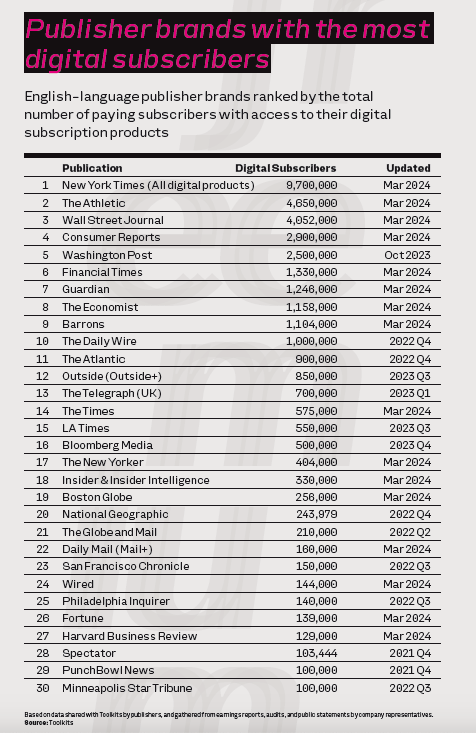
We know, of course, that the former, The New York Times example, has been wildly successful with the company recently reporting that it has crossed the milestone of 10 million subscribers. A handful of other publishers like Bloomberg and the Financial Times have managed to scale up subscriber numbers significantly while smaller organisations have successfully managed to launch membership strategies for reader revenue and build out communities. But what of the vast middle? The medium and even largersized publishers who may have come to the subscriptions game only in the last few years and have to contend with a challenging market and balance the pressures of building out subscriptions businesses while still being very dependent on print or digital ad revenue? What is the best strategy for them to follow when it comes to subscriptions and paywalls?
We’re here to break all of that down for you, starting first with a round-up of some recent discussions on where exactly news businesses stand with subscriptions. Earlier this year, Axios reported, via the ever-excellent media reporter Sara Fischer, that news companies were reversing course on hard subscriptions, which they once saw as a safer alternative to a volatile ad market, in favour of membership programs, flexible paywalls, and more ads.
“A strategy focused mainly on subscriptions requires upfront spending on premium content. That takes time to pay off—and many publishers don’t have the cushion for that in the current ad slowdown,” Fischer writes. “At the same time, many outlets have learned that simply throwing a paywall up over your previously free content doesn’t work either. It throttles ad revenue without capturing enough new subscribers.”
Though the piece is largely U.S.-centric, Fischer quotes some interesting recent examples to support her case of publishers pivoting or half-pivoting away from a ‘hard’ subscription model.
● The Washington Post, which has lost roughly 500,000 subscribers since its Trump-era peak, is considering more dynamically priced subscriptions, its new CEO Will Lewis said in an interview with Semafor. “My hunch is that the existing model is creaking,” Lewis said in the interview. “We went from an advertising model to a subscription-based model, and that subscription-based model is now waning and then will enter a more significant period of decline.
● Time decided to drop its digital paywall last year in favour of reaching a broader audience with more ad-supported content.
● Quartz also made a similar move, dropping its paywall in favour of a membership model based on newsletter readers.
● The Atlantic shifted from a blanket paywall to a more dynamic approach that offers varying subscription prices.
● Gannett, the U.S.’ largest local newspaper company, began reducing the number of articles behind its paywall in late 2022 to boost the company’s ad revenue.

Does this represent a “great subscription news reversal” as the post was titled and do these developments point to the fact that news publishers might begin turning their backs on subscription models en masse? Not so much. And in the weeks since that Axios post a number of strong reports and commentary have emerged that paint a more nuanced picture.
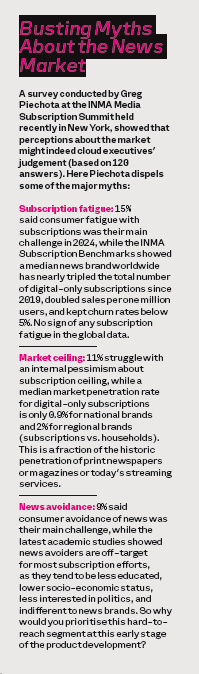
One of those voices is Greg Piechota, researcher-in-residence at INMA who runs its excellent Readers First Initiative Blog. “While a few smaller or niche brands like Quartz, TechCrunch, or Time have abandoned paywalls in the past year due to individual circumstances, claims of a great subscription reversal are unsubstantiated,” he wrote in a recent post. Piechota cites data and industry research that strongly suggest that the news industry is already making substantial money from readers, betting its future on reader revenue and doubling down. Among other he cites: Reports from PwC and WAN-IFRA that newspapers globally made US$34 billion from advertising last year but US$49 billion from circulation (both print and digital). Research by FT Strategies, Google and INMA survey that show that while print revenue streams are declining, publishers expect their digital consumer revenues to grow two to five times faster than digital ads over the next three years, depending on the region.
The “Journalism, Media, and Technology Trends and Predictions 2024” report from the Reuters Institute, which surveys news leaders from all over the world, in which a higher proportion of news executives said subscriptions were important (a rise from 74% in 2020 to 80% in 2024) than advertising (a decline from 81% in 2020 to 72% in 2024). In his own survey for INMA across 33 major markets, Piechota writes that, “the proportion of top online news outlets charging for content has increased substantially, from 26% in 2018 to 41% in 2022.”
But perhaps the key argument that Piechota presents is that of untapped market potential. “Per INMA Benchmarks, by the end of last year, a median national news brand sold digital-only subscriptions to only 0.9% of households in their market (a median regional brand penetrated 2%),” he writes. For instance, France’s Le Monde and Italy’s Corriere della Sera, which each boast 600,000 digital subscriptions, penetrate only 1.9% and 2.3% households in their respective markets. And The New York Times, with over 10 million subscribers, reaches only 0.8% U.S. households. Speaking at the Reutrer’s Institute recently, the Times’ publisher A.G. Sulzberger, said that all digital news subscriptions in the U.S. today add up to just 30 million to 40 million— fewer than the number of subscribers to the video streaming service Paramount+ which has 63 million. “I don’t think that our industry can or should accept that we are going to collectively be smaller than an eighthgrade streamer,” he said in his speech.

Writing also in response to the Axios Post, Toolkits’ Jack Marshall interviewed top executives to unearth some really interesting perspectives. Through a series of interviews the sense he got was that while publishers will continue to adjust and evolve their paywall and subscription approaches to ensure they’re extracting as much value as possible, many remain committed to subscriptions as a core pillar of their business models. “What is becoming increasingly apparent is revenue approaches must be employed carefully (and realistically) based on the nature of specific publishers’ editorial products and the interests and needs of their audiences. Throwing up a paywall on commoditised or low value content and hoping for the best isn’t going to cut it when it comes to building a meaningful subscription business,” Marshall writes.
Rameez Tase, president of subscription analytics firm Antenna also weighed in on X in response to the examples that Axios cited of news companies going back on subscriptions. “For many of these examples, it has absolutely nothing to do with the business model, and everything to do with product/market fit. For others, there are a dozen variants of what a subscription model could look like and the executives would do better to align their unique value proposition with a unique business model.”
In other words, as Marshall writes in his piece, “applying the wrong monetisation approach to a product doesn’t mean the approach in question is inherently flawed.
Rather, it means the product might be more effectively monetised through other means, or it simply lacks significant commercial value in the first place.”
“The #1 question each of these CEOs needs to ask is ‘Is my content commodity or scarcity?’ Unfortunately, all of these folks either didn’t ask that question or answered naively/dishonestly,” Tase added in his post.

We spent some time going over the recent debates and discussions on this topic because we hope it gives you context and a range of perspectives. At INNOVATION, we have long been advocates of publishers adopting paywalls and subscription strategies. Yet, we realise also that there is no one size fits all approach that can work for all publishers, and that no one business model can be a silver bullet.
This is why we have always advised that a subscription model should ideally form 40% of revenue for a successful media business, leaving some space open to get in advertising revenue which is the second most important business model. What is the best way to approach this balance or dance, if you will, between the two? To build a stable reader revenue base that insulates you from slumps in an unpredictable digital ad market while allowing you to take full advantage when it is buoyant.
We focus on this chapter predominantly on the Freemium paywall model which is emerging as the definitive way to extract maximum value from audiences while keeping a healthy growth in advertising. But we also discuss some variations, particularly the dynamic paywall which brings in elements of differential pricing. There are hi-tech approaches to creating a dynamic paywall, as you will read, but it’s also not as hard as you think!

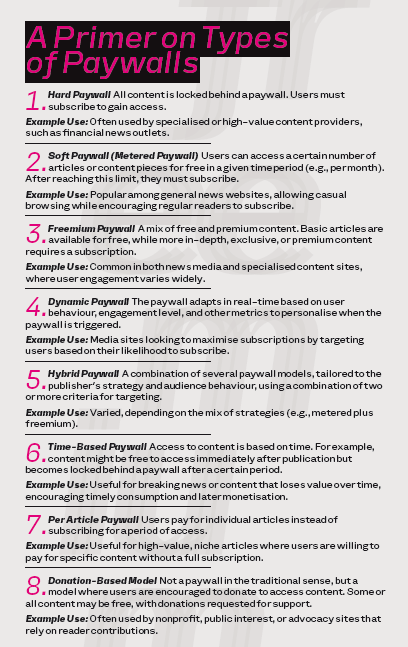
In an article for Toolkits, Jack Smith notes a trend among publishers who originally adopted metered paywalls for their content: they are now shifting towards freemium models. This shift involves removing their metered access and instead designating a larger or specific segment of their content exclusively for those who subscribe. Additionally, publishers previously utilising freemium models are now incorporating elements of metered access to develop “hybrid” models. in the hope that additional content restrictions will drive more readers to become paying subscribers. This typically involves reserving a distinct portion of content for subscribers and metering everything else.
Research shows that the freemium paywall model has been the most commonly adopted approach worldwide over the past few years, while hybrid models have been gaining traction. Greg Piechota writes in the INMA Readers First Initiative Blog that despite the differences in these models, brands employing various strategies have seen similar growth in their subscriber bases over this period. This observation comes from comprehensive research spanning several years, which included testing 473 websites across 33 countries and analysing the subscription performance of 160 brands.
The study highlighted some distinct trends, notably the rising popularity of hybrid models. Initially, these models accounted for 3% of the strategies observed in 2018, increasing to 5% by 2020, indicating a growing interest among publishers in exploring innovative approaches to content monetisation.
The freemium model is increasingly recognised as an optimal strategy for balancing subscriptions and advertising revenue for several compelling reasons: Balancing Accessibility and Revenue: The freemium approach skillfully bridges the need for widespread content accessibility with the imperative to generate sustainable revenue. Offering a significant portion of content for free enables publishers to attract high traffic volumes, essential for ad revenue.
Simultaneously, premium content acts as a clear value proposition, encouraging dedicated readers to subscribe for exclusive or in-depth material. This strategy caters to both casual and serious readers, optimising revenue from ads and subscriptions.
Diversifying Revenue Streams: In an era marked by volatile digital advertising revenues and the whims of algorithm changes, the freemium model offers a diversified revenue strategy. By leveraging both ads and subscriptions, publishers can mitigate risks associated with fluctuations in the digital advertising market. Subscription revenue from premium content provides a stable, predictable income stream, crucial as adblocking technologies become prevalent and competition for digital ad spend intensifies.
Enhancing User Experience and Engagement: Freemium models significantly enhance user experience and engagement, vital for building loyalty in the digital age. Allowing access to a portion of content for free engages a broader audience and fosters regular readership habits, potentially leading to higher subscription conversions. This approach also maintains the publisher’s visibility on search engines and social media, key channels for discovery and traffic. Incorporating specific insights from Smith’s article in Toolkits, he notes that freemium models are typically far easier for audiences to understand since the proposition is clear: Some content is free, and other content requires payment. He argues that if executed and communicated effectively, readers shouldn’t be confused about where and why they’re encountering locked content.
Adapting to Consumer Expectations and Behaviours: The freemium model offers a “try before you buy” experience, aligning with contemporary consumer expectations and demonstrating the publication’s quality to encourage subscription purchases. Its flexibility allows publishers to dynamically adjust the mix of free and premium content, ensuring effectiveness over time based on data-driven insights into user behaviour and preferences.
Supporting Strategic Content Monetisation: The freemium model facilitates a strategic, data-driven approach to content monetisation. Publishers can identify content that drives engagement and subscriptions, tailoring their strategy to either highlight high-demand content behind the paywall or offer certain topics for ad-supported free access. This flexibility supports ongoing optimisation and refines both content creation and monetisation strategies.
By contrast, Smith writes that gleaning actionable data from metered paywalls is more complicated. “Since meters primarily monetise broad consumption, the immediate insights they provide about audience interest and intent are relatively weak. A reader might convert on a piece of content after hitting a meter limit, but have actually derived significantly more value from three pieces they accessed prior.”

Effective Subscriber Conversions: Freemium models are often more adept at converting subscribers more effectively than metered models by monetising beyond a core group of highly engaged users. They enable publishers to generate demand with free content before upselling to premium, subscriber-only content and features. “Many publishers find that generating demand with freely available content before upselling audiences to premium, subscriber-only content and features is often a more effective strategy than simply taxing their most loyal and engaged audiences with a meter,” Smith writes. “From a product and marketing standpoint, ‘unlimited access’ is rarely viewed as a particularly attractive feature anyway. Audiences typically gravitate to products oriented around scarcity, efficiency, and concentrated value, rather than those that require high-volume consumption to justify their price points.”
Stronger Content and Products: Freemium models necessitate a deliberate approach to content and product development, requiring publishers to package compelling content into coherent products. This model encourages a subscription-centred organisational mindset, aligning editorial teams more closely with audience needs and interests.
“Successful freemium models require a far more deliberate approach to content and product development. Publishers must spend time packaging compelling content and features into coherent products that justify premium pricing, and arbitrarily placing content behind a paywall without rhyme or reason is not a recipe for long-term success. This may require adjusting their editorial mindsets and output, hiring staffers with expertise in new areas, or creating dedicated teams responsible for generating subscriberonly content,” Smith writes.
Security and Revenue Stream Impact:
Freemium models are often more secure than metered ones as they clearly separate free from subscriber-only content, mitigating ways for users to circumvent paywalls. The technology may also be a factor here, as in many cases, metered paywalls are implemented with client-side technology, while more secure server-side approaches power freemium models.

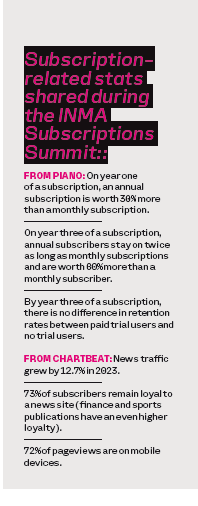
We mentioned of course that freemium paywalls are the most popular now internationally, according to an INMA survey. While there are several case studies to cite, we’ll hone in on some recent examples that have made news. What links them all, interestingly, is that they are all tabloid publications and historically, tabloids have been hesitant to charge their readers for news access. This shift represents a significant change in strategy
Daily Mail
Earlier this year, the Daily Mail, one of the world’s most popular news sites, embarked on a strategic shift towards a “freemium” subscription model. This move involves placing a curated selection of MailOnline articles behind a paywall each day, specifically targeting UK readers as part of an initiative to enhance revenue streams.
In a detailed rollout of this strategy, MailOnline has introduced a system where readers in its primary market, the UK, are required to pay for access to 10-15 articles daily. This information comes from an individual well-acquainted with the publication’s strategy, who also noted that this change would not extend to the overwhelming majority of content. Despite this new paywall, nearly 1500 stories that MailOnline publishes daily will continue to be accessible without charge.
The decision to implement a partial paywall signifies a considerable pivot in strategy. Previously, the platform stood firm in its stance against charging readers for content. This new model affects only the UK audience, where MailOnline boasts a monthly user base of 23.9 million and is the second most frequented news site, trailing only behind the BBC.
In a conversation with Press Gazette, Danny Groom, the editor/publisher of MailOnline, emphasised the strength and opportunity this model brings. He highlighted that MailOnline is initiating this partial paywall from a “great position of strength,” attributing this to its “huge, loyal, engaged, direct audience.”
Groom said the Mail Online’s strong direct readership makes it “the envy of the publishing world” and presented an opportunity to deepen relationships with those people.
He said: “It’s a tough time in the industry, of course, but I think people here recognise that being able to invest and to launch new products and to diversify is our way of future-proofing.”
Blick
The Swiss German-language newsbrand Blick first envisioned charging for its content online 12 years ago, as per reporting from Press Gazette, but it didn’t go live with its freemium paywall until June last year. In the eight months since the numbers have been astronomical; Blick+ has secured more than 16,000 subscribers— almost 80% of whom were already signed up to its free registration wall. Blick The Swiss German-language newsbrand
Speaking to Press Gazette,
AdrianGottwald, head of reader revenue at Blick Group, said the registration wall, which started being rolled out around five months before the paywall, “was maybe the key element for our successful launch”.
The registration wall strategy began by limiting just one article each day to a small group of users, only 2% of the total audience, to see how they would react to content restrictions. Over time, this approach expanded, eventually applying to ten to twelve articles per day for the entire Blick audience, which numbers around 1.2 million people. The articles selected for these restrictions were carefully chosen because they were seen as valuable enough that people might consider paying for them through a subscription to Blick+.
The Blick+ subscription model currently limits about 10% of the site’s content, or roughly 200 articles each month, to its subscribers. Gottwald explained that they chose this approach because they wanted to give subscribers access to a wide range of content without significantly reducing the site’s ad revenue. Additionally, subscribers enjoy extra
benefits like tours of the newsroom and discounts on events, adding more value to their subscription. Blick+ has already been cited, along with Bild in Germany, as a guiding model for Mail Online’s new freemium paywall approach.
Gottwald also shared the story of how they decided to start charging for some of Blick’s online articles. Back in 2012, they thought about adding a paywall but realised their website wasn’t popular enough yet, and not enough people were visiting it regularly. They focused on getting more visitors, and now they have over 1.2 million people coming to the site every day, out of the nearly 6 million German speakers in Switzerland.
They also worked on making their articles better and more interesting, choosing to cover more serious news and political stories instead of just sensational topics like scandals. After working on these improvements and growing their audience for about two years, they felt ready to introduce the paid subscription option in June. This plan made sure they had a strong foundation, with lots of readers and better content, before asking people to pay.
Bild
Another recent story reported by Press Gazette as it has direct links to the Daily Mail freemium paywall story – Bild being one of the models it was inspired by. Despite much success with their paid offering, the head of the digital subscriptions strategy at German tabloid Bild believes it still has “huge potential” and has not yet hit its growth ceiling almost 11 years on.
“Bildplus, which launched in June 2013, hit 700,000 digital subscribers in late 2023 and is now up to 707,208. This makes it the biggest subscriber base in the German-speaking news market and one of the most popular paywalled news websites in the world,” as per the Press Gazette piece.
About 12 to 15% of all the news brand’s online content is paywalled and the aim is for about 30% of articles in the top section of the homepage to be subscriberonly. Daniel Mussinghoff, director of premium for Bildplus, said the offering has “more digital subscribers than others have in their print legacy business” in Germany and while they are happy with those numbers they still see room to grow. According to Mussinghof, Bild’s website gets around 18 million visits per day from five to six million unique users. And although Bild has begun receiving feedback from users about their budgets being squeezed, the cost of living crisis and high inflation has still not led to a decline in subscriber numbers, with subscribers still growing every month.

Recent research by FT Strategies into the paywalls and pricing models of 35 publishers of record across Europe and North America gives us a sharper understanding of where the industry is heading with regard to digital revenue.
They identify three clear shifts: Fading Free Access: A mere 6% of publishers stick to entirely free content models, moving towards digital revenue generation through memberships or donations (e.g., The Guardian, Il Post).
Decline of Metered Models: Traditional metered paywalls, offering a fixed number of free articles, have drastically decreased from 35% to 9%, making way for more nuanced approaches. Most of those who used metered have moved to either:
● Hard Paywalls: have seen a 13% increase, often requiring registration for limited content access, a strategy employed by The Economist, The Spectator and Bloomberg to enhance data collection.
● Dynamic/Hybrid Models: have seen a notable 10% growth, particularly in North America. These innovative paywalls adjust content access and pricing based on user interaction and engagement, exemplified by The New York Times, The Wall Street Journal, and The Globe and Mail.
In terms of performance compared to standard models (freemium, metered or hard), dynamic paywalls present users with a conversion journey, messaging and design that is most optimal for converting that specific type of reader into a member or subscriber. For this reason, they are recognised now as the optimal model for increasing conversion rates and ARPU.
Dynamic paywalls will also make better sense in a cookie-less future. They are repositories of first-party data—the source of rich and nuanced audience insights that can help optimise your audience and traffic, and maximise revenue potential.
Let’s discuss in detail some of the most well known examples that FT’s research highlights:
The New York Times
The Times is, of course, recognised for operating one of the most emulated metered paywalls globally. But like most things to do with operating a digital business, it has not remained stagnant in its approach. Rather, it has innovatively integrated machine learning to render its paywall more dynamic. This advancement is elaborately discussed in a blog post on the INMA website, showcasing how The Times has adapted and thrived in the digital subscription space.
The Times employs a strategic approach with its paywall, revolving around the concept of a subscription funnel. Initially, unregistered users can access a limited number of articles for free. Once this limit is reached, they encounter a registration wall urging them to create an account.
Creating an account allows users to access additional content for free, enabling The Times to better understand their preferences through their reading habits. Eventually, these registered users meet another limit, which triggers a subscription offer.
This critical juncture is managed by a Dynamic Meter, a sophisticated tool that adjusts the article limit for each user based on their engagement, optimising the moment to present the subscription offer. The goal is to find the optimal balance between keeping readers engaged and converting them into subscribers.
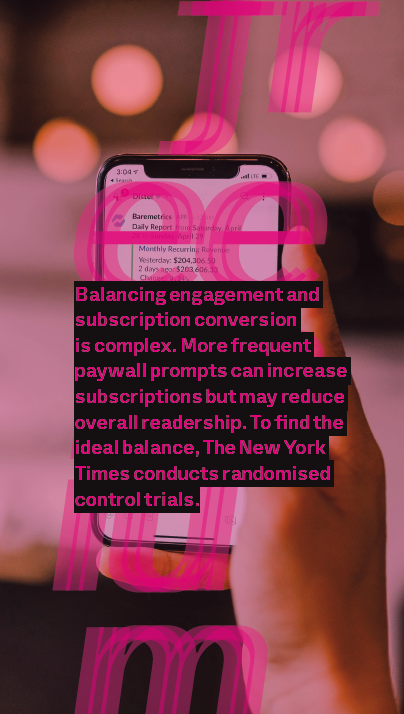
Balancing engagement and subscription conversion is complex. More frequent paywall prompts can increase subscriptions but may reduce overall readership. To find the ideal balance, The Times conducts randomised control trials, varying the article limits to observe effects on reader engagement and subscription rates.
The blog explains that the Dynamic Meter is a prescriptive machine learning model that assesses the impact of different article limits on user engagement and likelihood of subscribing. It adjusts these limits based on a set of objectives, fine-tuning the balance between reader engagement and subscription conversion based on the outcomes of these trials.
Wall Street Journal
After years of extensive testing, The Wall Street Journal has refined its paywall to adapt to the habits and potential subscription likelihood of its individual readers. Visitors to WSJ.com are assessed with a score based on a wide array of factors, which then determines how the paywall applies to them.
This scoring system is informed by over 60 different signals—ranging from the type of device used to geographical location and browsing behaviour—all aimed at predicting a visitor’s propensity to subscribe. The Wall Street Journal’s use of machine learning in this context eliminates much of the guesswork traditionally involved in deciding how much access to grant non-subscribers.
The Journal categorises visitors into “hot”, “warm” or “cold” groups based on their subscription likelihood scores. High scorers encounter a hard paywall, while those with lower scores might enjoy more free content in a session or be offered guest passes. These passes, which require an email address in exchange, allow the Journal to gather even more data to refine its predictive model.
“If you think about paywalls broadly, there have been metered, freemium, and hard paywalls. Metered considers people who will want to read more than, say, five stories. Freemium assumes this and not that is the type of content people will pay for,” Karl Wells, formerly GM of membership,subscription sales and marketing, told NiemanLab. “This is what we’ve tried to move on from. Our model now is to flip that and start with the reader. The content you see is the output of the paywall, rather than an input.”
Moreover, the strategy behind guest passes and targeted emails based on reader scores underscores the Journal’s nuanced approach to converting readers into subscribers, without altering the subscription cost based on the propensity score. This model not only personalises the reader experience but also bolsters the Journal’s subscription base through a more informed and strategic engagement with potential subscribers.
The Globe and Mail – Sophi The Globe and Mail, one of Canada’s premier newspapers, has been making waves for some years now with its stateof- the-art paywall system powered by an AI programme called Sophi. Developed in-house, Sophi is all about smart decision-making. It doesn’t just decide which articles to push on social media or feature on the homepage; it’s got a bigger job—figuring out when to show readers the paywall. But it goes deeper than that: Sophi tailors this experience to individual readers. Depending on what you read, you might never bump into a paywall or you might hit one every time you visit. Imagine a reader who loves diving into general news and the occasional recipe. Sophi might test the waters by presenting a paywall, but if the reader doesn’t bite, it won’t keep nagging them. Instead, it might suggest signing up with an email for more access. It’s like Sophi knows when to push and when to pull back, optimising the delicate balance between
ad revenue and potential subscriptions. The beauty of Sophi lies in its adaptability. There’s no one-size-fits-all article limit here. Your chances of hitting a paywall could depend on anything from your reading habits to where you’re reading from. This AI is making calculated decisions on whether to chase ad dollars or nudge you towards a subscription. “It knows when to give up,” as Sonali Verma, former director of business development for Sophi, puts it. Sophi understands that pestering someone unlikely to subscribe is just not worth it. Instead, it focuses on nurturing potential subscribers in a more personalised way, making the whole experience less about intrusion and more about invitation. Sophi has significantly boosted both email registrations and subscription conversions, enhancing engagement and loyalty among readers. Even with all this tech, the human element isn’t lost. The newsroom can override Sophi’s decisions anytime, ensuring that editorial judgement always has the final say, especially in critical situations.
The Atlantic
In a strategic move reported by Digiday, The Atlantic recently implemented a dynamic paywall at the start of this year, setting its sights on reaching a milestone of one million subscribers by the end of 2024.
Nick Thompson, CEO of The Atlantic, outlined the magazine’s plans to bolster its subscriber numbers by an estimated 30,000 by the year’s end. The introduction of a “smart meter” is central to this strategy, aiming to attract about 125,000 new subscribers over the next two years. Developed internally and tested since last summer, the paywall adjusts its approach based on a reader’s interaction with the site, introducing a flexible pricing model. Subscription rates will vary between $60 and $100, diverging from the standard rates to explore potential revenue increases per reader.
The tests of this variable pricing model have shown promise in growing The Atlantic’s subscriber base and increasing its Average Revenue Per User (ARPU), although specific figures were not disclosed. Importantly, Digiday reports that these changes have not negatively impacted churn or bounce rates.
The dynamic paywall represents an evolution from The Atlantic’s initial metered model launched in September 2019 and signifies a more nuanced approach to balancing advertising potential with subscription revenue. With the new model, the paywall can be shown to readers who are more likely to subscribe as opposed to its previous metered paywall which readers hit after a few articles, regardless of who they are.
The dynamic nature of the paywall allows for flexibility in response to the advertising climate. For instance, if there’s a surplus of direct-sold ad inventory, the paywall can be adjusted to ensure sufficient site traffic to meet ad impression goals, then tightened again as needed. Megha Garibaldi, The Atlantic’s chief growth officer, described this as a “dance” between optimising advertising and subscription revenues.
The Digiday piece also reports that Piano, one of the largest paywall tech companies in media, is beta testing a similar dynamic pricing feature with five clients that will allow publishers to “create more complex subscription pricing models,” according to Michael Silberman, Piano’s EVP of strategy and social. He argued it’s not that different from a “classic magazine or newspaper strategy of stepup pricing” where readers start at a lower introductory price and then the price increases over time.
Swiss newspaper Neue Zürcher Zeitung (NZZ) has made significant strides in personalising its digital experience with the use of dynamic paywalls, proving the effectiveness of this approach in the digital publishing landscape. Following a strategy similar to The Wall Street Journal, NZZ employs a complex algorithm that utilises between 100 to 150 variables, such as reading history, time on articles, visit frequency, device used, newsletters received, and visit timings, to calculate a reader’s propensity to subscribe.
“We play around with the threshold,” Steven Neubauer, former MD, NZZ told Digiday. He explained that people can see payment messages after they have read five, eight, 11 or 13 articles. “Ultimately, the goal is to not disrupt the product experience; we only want to disrupt when someone is willing to pay. This approach ensures that the paywal intervention is as seamless as possible, enhancing the user experience by tailoring the message, text, placement, timing, and even colour of the pay prompt to the reader’s likelihood to subscribe.
The integration of machine learning and AI into NZZ’s system removes much of the uncertainty surrounding subscription conversion, enabling a more targeted approach to reader engagement. By analysing data on reader behaviour, NZZ can distinguish between those who are likely to subscribe upon encountering a paywall and those who are not, thereby customising the digital experience for each user.

(in an accessible way)
You may think by now that implementing a dynamic paywall requires expensive, complicated machine-learning algorithms and that whole process might take a lot of time. What if you’re a smaller publisher who is short on both time and money but looking to experiment? To help with that, Madeline White, Editor-in- Chief of The Audiencers has a wonderful guide to demystifying dynamic paywalls and some tips on running experiments to help you adapt your paywall offering.
Implementing a simple but effective dynamic paywall strategy
If you don’t yet have a subscription model in place, White recommends starting with an anonymous to known (registration) strategy before launching straight into subscription.
“Ask your users to create a free account in exchange for access to more content and other benefits, allowing you to collect first-party data, assign this data to a single reader ID and work to increase engagement over time for this known user,” she writes.
“Not only this, but registration also supports revenue diversification as it increases both advertising revenue and propensity to subscribe.” Moving on from that first step:
Choose how to segment your audience based on data.
● Source of traffic, e.g., Facebook/Twitter vs Direct vs Newsletters
● Level of engagement, e.g., Volatiles, Ocasionals, Regulars & Fans – this could be based on the RFV (recency, frequency, volume) score used by Financial Times with divisions between each segment being defined based on your audience behaviour
● Anonymous vs registered
● Location, e.g., France vs United States
● Device used, i.e., mobile vs desktop
● Never subscribed vs ex-subscriber
● Content type, e.g., politics vs news vs lifestyle Test wall variations to discover which works best for each audience segment Here’s a list of things you can test:
● The design: colours, images, photos (e.g., test adding a photo of a journalist), format (banner, box or pop-up)
● The offers: annual vs monthly pricing, discounted offer, number of offers on the wall…
● The wording: value proposition, personalisation to the person or the content-type…
● Form fields in the wall: email collect, name, etc
“Importantly, you should define what success looks like for a wall,” White writes. “Traditionally, these are clickthrough or user-to-subscriber conversion rates, however we’d also recommend thinking about the steps in the reader funnel toward subscription, because a user is highly unlikely to arrive on your website for the first time and subscribe. This funnel will therefore look different for each user segment.”
“For instance, for anonymous users, success might be converting them into a registered member. For traffic coming from social media sites, it could be to sign them up to your newsletter to increase engagement and form a content consumption habit.” To finish up this chapter we’ll recap some of the best examples that White has showcased. Here’s hoping that it helps you rethink your paywall strategy going ahead.

Jeune Afrique
Audience segmented by: location
Dynamic element: value proposition messaging
White writes: “This messaging repositions the publisher as not only one that covers news across the continent, but also on a more local, national level, providing news on the subjects that matter to the reader’s own community. This simple change to their value proposition means they can convey similar values as smaller, local publishers who often have a tighter-knit, more engaged community of readers who buy into the media’s mission.”
Financial Times
Audience segmented by: Location
Dynamic element: Value proposition messaging
White writes: “FT modifies the value proposition messaging based on a user’s location, with the first being presented to UK readers, whilst the second is for those reading from the US. Especially with niche content such as this (FT covers financial and political news), user interests will differ greatly across the world and even within a given country. Given that FT is a UK publisher, American readers need a different reason to subscribe (aside from simply to hear about political and financial news).
Messaging needs to tell these audiences why they should choose FT over an American equivalent.”
ELLE Magazine
Audience segmented by: Type of newsletter subscription
Dynamic element: The value proposition, benefits of subscription and image
White writes: “This is a brilliant, very simple but effective strategy. Thanks to the newsletter, you know that this reader has an interest in this specific topic, so why not maximise this insight to better convert them into a subscriber? Whilst the premium offer being promoted is the same in both cases, the benefits being forefronted are adapted to the reader’s interest, helping them to see the value of converting.”
Le Journal du Dimanche
Audience segment: users who had already started the subscription process but had abandoned before payment
Dynamic element: Value proposition messaging
White writes: “Focus is on the simplicity and speed of the conversion process (“a single click”) and the benefits of doing this action (“access to all articles”) helping to
give a final nudge to this audience segment who are so close to subscribing.” ◍
The Innovation in News Media World Report is published every year by INNOVATION Media Consulting in association with WAN-IFRA, The report is co-edited by INNOVATION President, Juan Señor, and Senior Consultant Jayant Sriram